


What is Critical Thinking?
The ability to think critically calls for a higher-order thinking than simply the ability to recall information.
Definitions of critical thinking, its elements, and its associated activities fill the educational literature of the past forty years. Critical thinking has been described as an ability to question; to acknowledge and test previously held assumptions; to recognize ambiguity; to examine, interpret, evaluate, reason, and reflect; to make informed judgments and decisions; and to clarify, articulate, and justify positions (Hullfish & Smith, 1961; Ennis, 1962; Ruggiero, 1975; Scriven, 1976; Hallet, 1984; Kitchener, 1986; Pascarella & Terenzini, 1991; Mines et al., 1990; Halpern, 1996; Paul & Elder, 2001; Petress, 2004; Holyoak & Morrison, 2005; among others).
After a careful review of the mountainous body of literature defining critical thinking and its elements, UofL has chosen to adopt the language of Michael Scriven and Richard Paul (2003) as a comprehensive, concise operating definition:
Critical thinking is the intellectually disciplined process of actively and skillfully conceptualizing, applying, analyzing, synthesizing, and/or evaluating information gathered from, or generated by, observation, experience, reflection, reasoning, or communication, as a guide to belief and action.
Why Is Critical Thinking Important?
Our students need to be able to think critically to make rational decisions on what to believe or what course of action to take.
An inability to think critically can leave students vulnerable to muddied thinking and the possibility of believing in unsound ideas.
Critical thinking helps students to filter the wheat from the chaff, intellectually speaking.
Developing strong critical thinking skills helps students to eliminate dubious data to leave only the strongest, most reliable information.
At its core, critical thinking is about having good reasons for our beliefs. It helps us to navigate through bias (our own and that of others) to avoid manipulation or becoming enslaved by our feelings. These are essential skills in an age of overwhelming information.
Helping our students to develop their critical thinking skills not only inoculates them against embracing flawed ideas, but these skills are also some of the most in-demand by employers and this looks set to continue to be so well into the future.
This is due to the ever-increasing pace of technological change. It is impossible to accurately predict the specific requirements of many future jobs. One thing is for sure though, so-called soft skills such as critical thinking will ensure students will be able to adapt to whatever shapes the workplace of the future will take.
Teaching Strategies: A Step-by-Step Approach to Critical Thinking
The following process is a useful template to teach students. When embarking on their own research, this template provides a step-by-step process which they can use to structure their investigations.
1. Format the Question
In the age of the Internet, access to information is longer the major hurdle facing the inquisitive student investigator. If anything, the real problem now is knowing how to appropriately sift through the almost inexhaustible amount of information out there.
The key to this filtration process is the formulation of the research question. How the question is composed and formatted will inform exactly what information the student is looking for and what information can be discarded.
The type of question formatted here will depend on the purpose of the research. For example, is the question intended to establish knowledge? Then, it may well be a straightforward What type question, for example, What are the consequences of a diet high in processed sugars?
If the question is geared more towards the use of that information or knowledge, then the question may be more of a Why type question, for example, Why do some commentators claim that a diet high in processed sugars is the greatest threat facing public health?
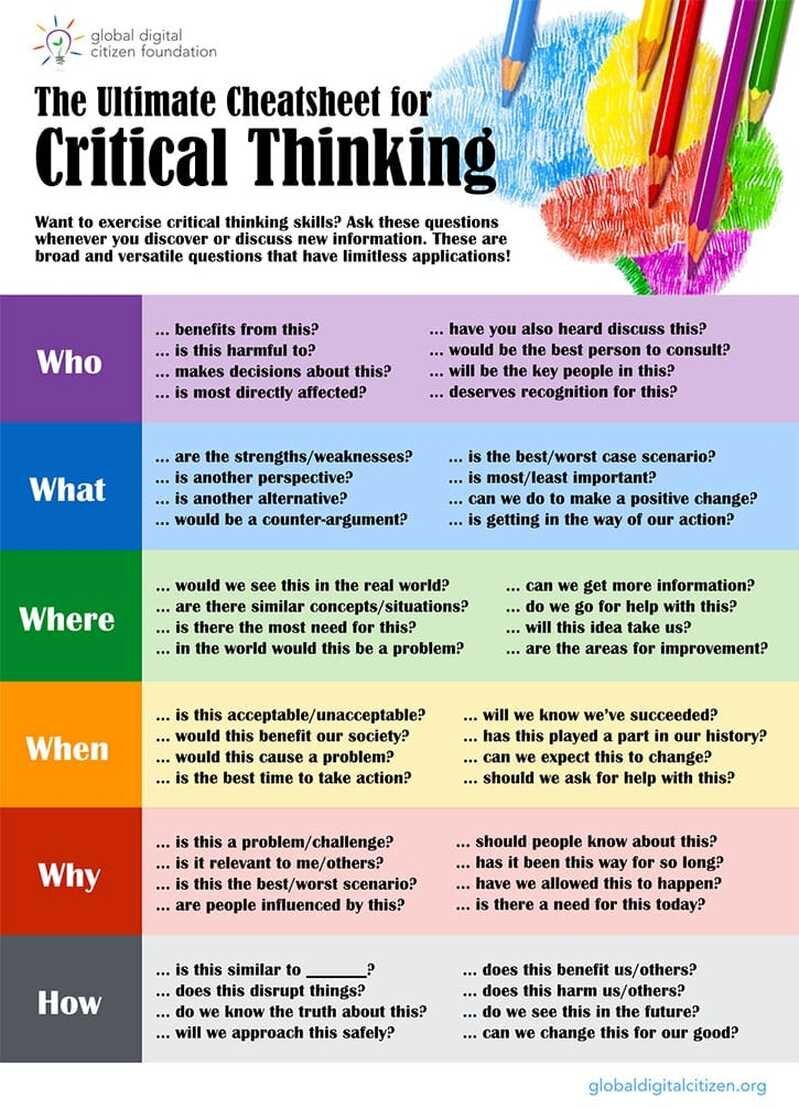
One extremely useful tool to assist in formatting questions that make demands on student critical thinking abilities is to employ Bloom’s taxonomy.
2. Gather the Information
Once the question has been clearly defined, then the process of gathering the information begins. Students should frequently refer back to their research question to ensure they are maintaining their focus.
As they gather information in relation to their question, reference to their initial question will help them to determine the relevance of the information in front of them. They can then weigh up whether or not the information is helpful in moving them further towards answering their initial research question.
3. Apply the Information
The ability to think critically about information is of no use unless the understandings gained can be applied in the real world.
The most practical application of this skill is seen when it is used to inform decision-making. When faced with making a decision, encourage students to reflect on the concepts at work in regards to the choice they face.
They must look at what assumptions exist and explore whether their interpretation of the issue is a logically sound one. To do this effectively, they will also need to consider the effects of that decision.
4. Consider the Implications
“The road to hell is paved with good intentions.”
As the old proverb suggests, our well-intended decisions can sometimes lead to unforeseen negative consequences. When considering paths of action, we need to encourage our students to reflect deeply on all possible outcomes of those actions: short, medium, and long term.
Unintended consequences are outcomes that are unforeseen and can often undo much of the good of the original decision.
There are many fascinating examples of this phenomenon that are easily found online and can be interesting to share with the students.
One such example was uncovered by the economist Sam Peltzman. He found that when mandatory seat-belt legislation was passed in some of the US states the number of fatalities of drivers did go down as a result. However, he also found that this was offset by an increase in fatalities among pedestrians and cyclists as drivers felt safer wearing seat belts and many drove faster as a result.
5. Explore Other Points of View
This is the final testing ground of an opinion that has been forged in the fires of critical thinking. Though students will have been exposed to competing ideas earlier in the research stage, they should now take the time to measure their matured opinion against these other points of view.
Exploring alternative viewpoints helps us to evaluate our own choices and to avoid stagnating in our own biases and innate preferences. Doing this helps us to make the most informed decisions possible.
Now that we’ve had a look at a step-by-step approach to critical thinking, let’s take a look at some creative ways to help students exercise those critical thinking muscles in the classroom. Getting critical doesn’t have to be boring!



Leave a Reply